Scandinavian Christmas patterns: Nordic motifs, colours and project ideas
Dala horses, gnomes, knitted stars and folk flowers each come from a real Nordic tradition. This guide explains the main motifs and colours, then turns them into gift wrap, cards and festive sewing.
Updated
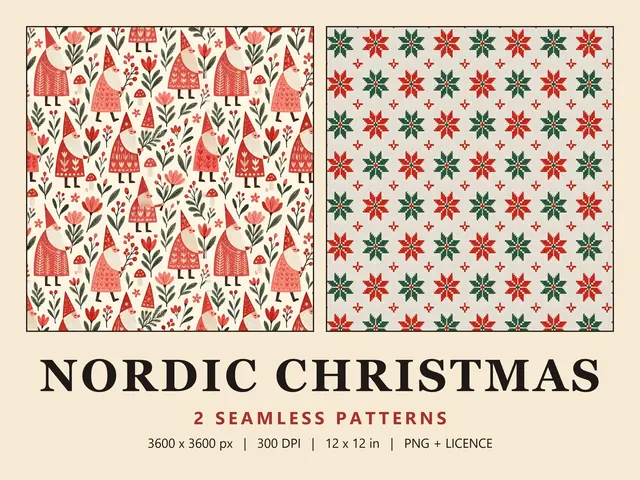
The motifs behind Nordic Christmas patterns
Most Scandinavian Christmas designs draw on a small set of motifs from Swedish, Norwegian and Danish folk tradition. Knowing where they come from makes them easier to combine.
- Dala horses: carved, painted wooden horses from Dalarna in central Sweden, made there for centuries and still produced mainly in Nusnäs, near Mora. The classic horse is red and decorated with kurbits, an ornate, often floral style of folk painting tied to Dalarna.
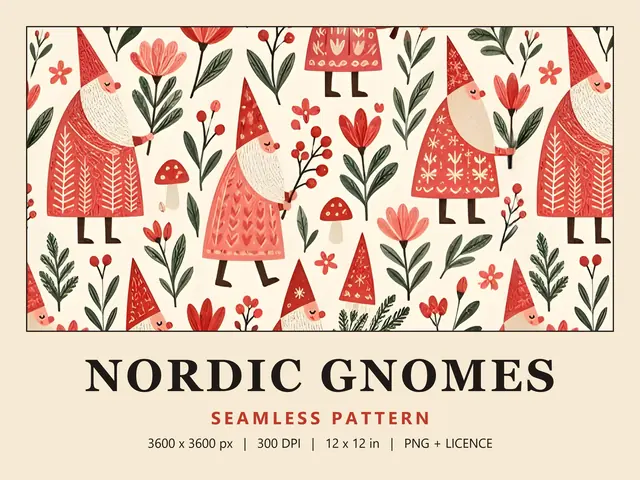
- Tomte and nisse: the Christmas gnome is the tomte in Sweden and the nisse in Norway and Denmark, a small farm spirit who protected the farm and its animals. He didn't bring gifts, but people left Christmas porridge out for him, and in Norway a bowl of rice porridge still goes out to the barn on Christmas Eve.
- Knitted stars: the eight-pointed star on Nordic jumpers and mittens is often called the Selbu rose, after Selbu in Norway, where two-colour knitting took hold in the mid-1800s. Marit Guldsetbru Emstad, a young knitter there, is credited with the design. Eight-pointed stars like it are far older and appear in many cultures.
- Reindeer: Nordic-style designs usually draw them either as blocky, stitch-like figures borrowed from colourwork knitting, or as folk animals with patterned bodies, close cousins of the Dala horse.
- Folk florals: stylised tulips, berries, hearts and scrolling leaves echo Swedish kurbits and Norwegian rose painting, which decorated furniture and household goods. For year-round versions, see the Folk & Scandi collection.
- The Yule goat: in the 17th and 18th centuries it was often Sweden's Christmas gift-bringer. Today it is mostly a straw decoration, and its simple outline works well as a small, scattered motif in Swedish Christmas patterns.
Any two-colour knit is often called Fair Isle, but Fair Isle is a Shetland tradition, named after the island. For a Nordic look, use the Selbu star.
Colour palettes that feel Scandinavian
Nordic Christmas palettes tend to be restrained: two or three colours on a pale ground.
- Red and cream: the classic, echoing red Dala horses and Falu red, the deep red paint made from by-products of copper mining at Falun and used on Swedish wooden houses.
- Red, green and cream: warmer and more traditional. The Scandinavian Christmas set uses tomato red, forest green and warm cream.
- Black and white: the colours of the first Selbu mittens, graphic and modern with natural linen.
- Muted naturals: oatmeal, soft grey, sage and faded red give a quieter, vintage feel.
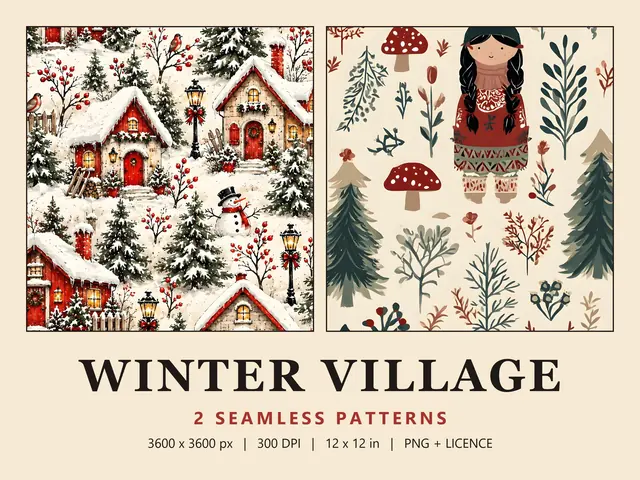
Pair one busy print with a simple coordinate in the same palette, such as gnomes or villages for the main surface and stars as the blender. Several sets in the Christmas collection pair their prints this way.
Paper projects: wrap, cards and tags
Christmas digital paper is simply a pattern file you print or use on screen. Because each Wild Little Designs pattern tiles seamlessly, you can print an area larger than one 12 in tile without a visible join.
- Gift wrap: busy prints, such as gnomes or villages, suit large parcels, and star prints suit small boxes.
- Cards: print a section of the pattern for the card front, or use a narrow strip of it beside a plain panel for your message.
- Gift tags: print a sheet of a small-scale star print on card, cut out the tags and punch a hole for ribbon.
- Envelope liners and scrapbook pages: use offcuts from the same sheets so everything matches.
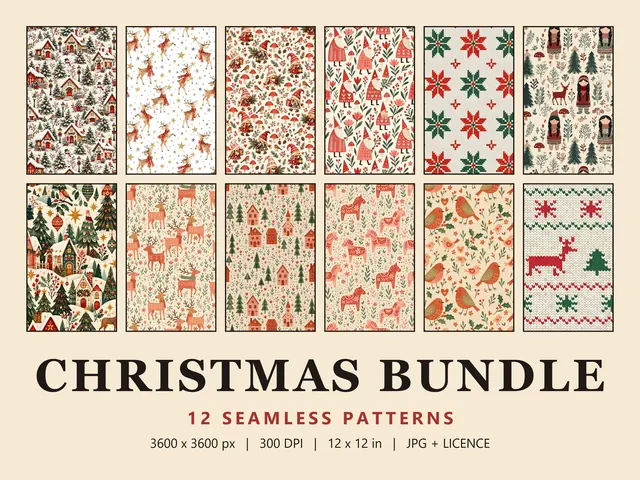
With a larger set, such as the 12 designs in the Nordic Christmas Bundle, decide early which prints become wrap and which become tags, so every parcel matches.
How to print your own gift wrap
A pattern file is a single tile, and a printer prints exactly the image you send. So the first job is to build a print file the size of your sheet.
- Choose the sheet: A4 or A3 from a home printer for small gifts, or larger sheets from a local print shop. Wrapping paper must fold cleanly, so ask for a thin paper and test a fold.
- Create a blank document at the sheet size at 300 DPI. An A3 sheet is 3508 x 4961 px.
- Decide the scale. At 300 DPI one repeat is 12 in, which suits big boxes. For small gifts, resize the tile to 1800 px for a 6 in repeat.
- Fill the document with the tile, edge to edge and unstretched. In Photoshop, open the tile and choose Edit > Define Pattern, then use Edit > Fill on the new document with Contents set to Pattern. Most design programs have a similar fill.
- Print one sheet and check the colour and the joins before you print the rest.
Sewing projects: stockings, tea towels and table linen
For fabric, use a printing service such as Spoonflower, and order a swatch on your chosen fabric before buying yardage.
- Stockings: cut the front and back as a mirrored pair so the print runs the right way up on both. A 6 to 8 in repeat suits the size.
- Tea towels: a star or single-motif print looks crisp at 6 to 8 in, on linen or cotton.
- Table runners and napkins: the busy print for the runner and its matching star print for the napkins.
- Children's Christmas pyjamas and dresses: the busy print for the main pieces and the coordinate for cuffs, collars and trims.
Gnomes, horses and reindeer have a right way up, so cut every piece in the same direction and allow a little extra fabric.
When to make and list Christmas products
For your own Christmas, paper projects can be made in an evening, even in December. Fabric needs longer: order a swatch, then yardage, with time for a second round if a colour isn't right. Printers and couriers get busier as Christmas approaches, so aim to order fabric by early November.
If you sell what you make, work further ahead: design and test samples in summer, photograph and list in September, and build stock through October, because holiday shoppers start browsing well before December. If that window has passed, plan for next year.
Printed gift wrap, cards, tags, stockings and table linen are physical products, so the licence lets you sell up to 500 units per pattern. What you can't sell is the pattern as a file, including printable gift wrap, digital paper or templates.
Questions
What is the Scandinavian Christmas gnome called?
In Sweden it is the tomte, and in Norway and Denmark the nisse. In folklore he is a small farm spirit who looks after the farm and its animals, and people traditionally leave Christmas porridge out for him. Jenny Nyström's illustrations, inspired by this farm spirit, helped shape the Swedish image of Santa Claus.
What is the star on Nordic Christmas jumpers called?
It is often called the Selbu rose, or selburose, after Selbu in Norway, where two-colour knitting took hold in the mid-1800s and the star became famous on mittens. The design is credited to a young knitter, Marit Guldsetbru Emstad, and the first mittens were black and white. Eight-pointed stars like it appear in many cultures.
What size is Christmas digital paper?
There is no fixed size, but 12 x 12 in is common because it matches scrapbook paper. The Wild Little Designs Christmas patterns are 3600 x 3600 px at 300 DPI, exactly 12 x 12 in. Because they tile seamlessly, you can also print them larger as gift wrap, or scale them down for tags and cards.
Can I sell gift wrap printed with these patterns?
Yes. Printed gift wrap, cards and tags are physical products, so you can sell up to 500 units per pattern. You can't sell or share the files themselves, including as printable gift wrap or digital paper, or upload them to print-on-demand sites.