Mudcloth patterns: where the style comes from and how to use it
Mudcloth began as bògòlanfini, a cotton cloth from Mali with its own history and visual language. This guide covers how the real cloth is made and what its patterns mean, then how to use mudcloth-inspired prints at home.
Updated
What mudcloth is
Mudcloth is the English name for bògòlanfini, a cotton cloth made by the Bamana (also called Bambara) people of Mali in West Africa, where it is central to Bamana culture. The Metropolitan Museum of Art translates the word literally: bogolan means something made using mud, and fini means cloth. You will often see it shortened to bogolan.
Classic pieces show off-white marks on a deep brown or black ground: lines, dots, crosses, zigzags and diamonds, often arranged in bands or panels. Since 1970 a revival has spread the cloth through Malian popular culture and into the work of international fashion designers, and its look now appears on everything from cushions to wallpaper.
How real mudcloth is made
The work is traditionally shared. Men weave cotton into long, narrow strips, which are sewn together edge to edge to make the cloth. Women then decorate it, and museum records describe young women learning the patterns from their mothers over a long apprenticeship.
- The cloth is soaked in a plant dye, which turns it yellow. This dye is what later reacts with the mud.
- Mud is collected and left to ferment, for up to a year according to the Victoria and Albert Museum.
- The artist paints the background with the mud, using a spatula or a feather, and leaves the motifs unpainted.
- Where the mud touches the dyed cloth, it darkens. Once dry, the mud is washed off.
- A caustic solution or a specially prepared soap is applied to the unpainted areas to remove the yellow, leaving the motifs off-white.
So the pale shapes in a classic piece are not painted on. They are the areas the artist painted around, and because every step is done by hand, no two cloths match exactly.
What mudcloth patterns mean
In Bamana tradition the cloth marked important moments. Hunters wore it, and women wore bògòlanfini wrappers at turning points in life: on reaching puberty, before the consummation of marriage and after childbirth.
The motifs carry meaning too. The Met describes them as usually abstract or semi-abstract representations of everyday objects which, used together, can express a proverb or a song, carry a message or represent a historical event.
Those meanings belong to particular makers, places and cloths, and they are known because someone recorded them. A cloth commissioned in 1969 from the artist Gneli Traoré, now in the Met, is a good example: Pascal James Imperato, who commissioned it, recorded the name of each pattern. One, Koumi Diosseni Kandian ('the long-necked'), honours Koumi Diosse, a folk hero of the Beledougou region who led a revolt against the French in 1915. Another, Turusina, translates as 'a helping hand', but its meaning has been lost.
This is why the many online charts of mudcloth symbols and meanings deserve caution. A cross or a zigzag has no single fixed meaning, and a pattern from outside the tradition, including every Wild Little Designs print, carries no traditional meaning at all.
Mudcloth-inspired prints and the real thing
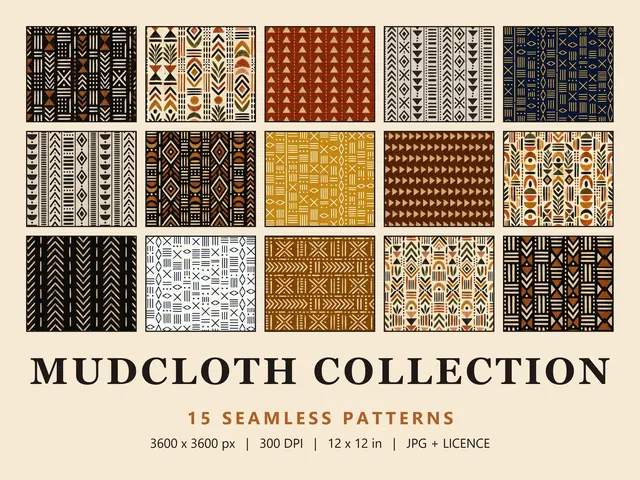
The mudcloth patterns in the Mudcloth & Boho collection are digital seamless patterns inspired by the look of mud cloth. They are not bògòlanfini, and their marks are not traditional motifs.
If you want the textile itself, buy cloth made in Mali. Look for sellers based there, or sellers who work directly with Malian artists and can name the maker or workshop and the town. Real bògòlanfini is built from narrow handwoven strips sewn together, so the seams show, and because it is painted by hand, every piece varies. Factory-printed cotton with a mudcloth look is a different product, whatever the label says.
The two do different jobs. A handmade cloth suits a throw, a wall hanging or a cushion you will keep for years. A digital pattern suits things you need to repeat, scale or recolour, such as wallpaper, gift wrap, stationery or fabric for sewing several items.
Using mudcloth prints in your home
Mudcloth-style prints are graphic, so they work best with some restraint.
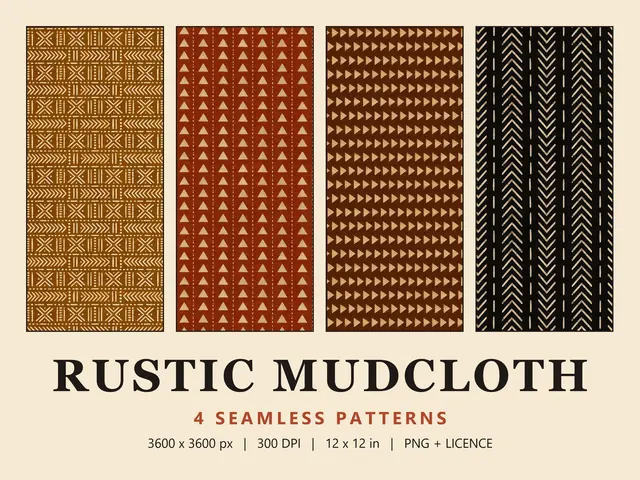
- Stay in one colour family. The Rustic Mudcloth set, in ochre, rust, cocoa and black, sits easily with linen, wood, rattan and terracotta.
- Mix scales. Put a busy print on a large surface, such as a throw or a feature wall, and a simple stripe or chevron on cushions.
- Leave plain space. One wall, one chair or one run of cushions in mudcloth, with plain textures around it, looks considered rather than crowded.
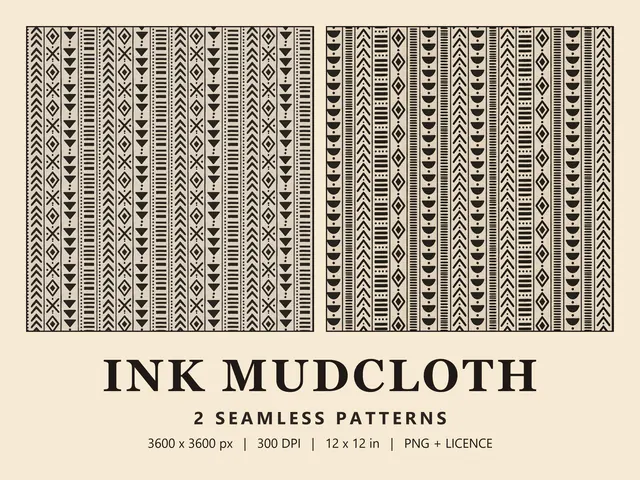
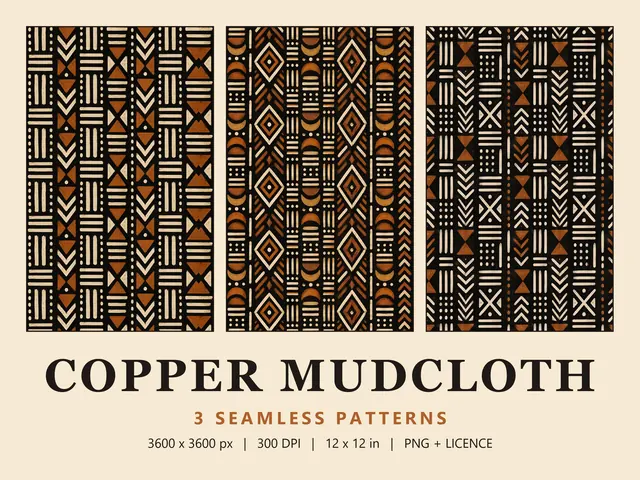
- Let the ground colour set the mood. Deep black grounds, as in Copper Mudcloth, anchor a pale room, while black-on-cream prints feel lighter and suit smaller spaces.
For wallpaper, a 12 in repeat reads as a fine texture across a wall, while a larger scale turns each mark into a feature.
Sewing projects with mudcloth prints
- Cushion covers: centre one band of motifs down the front panel so the design sits square.
- Tote bags and pouches: a smaller repeat, around 6 to 8 in, keeps the marks crisp on small panels.
- Table runners and napkins: stripes and chevrons follow the length of a runner neatly.
- Clothing: one-colour prints, such as cream on black, suit skirts, shirts and children's clothes.
- Quilts: use two or three prints from one set alongside plain fabrics, so each pattern has room.
Banded designs have a direction, so cut every piece with the bands running the same way. Order a test swatch on your chosen fabric before buying yardage, because colours shift from one fabric to another.
Under the licence, you can sell up to 500 finished items per pattern, such as cushions or bags. You can't sell the fabric itself or the files, or list the designs on print-on-demand sites.
Questions
What is mudcloth fabric made of?
Traditional mudcloth is handwoven cotton coloured with a plant dye and fermented mud. The cotton strips are sewn together, dyed yellow, then painted with mud, which darkens where it meets the dye. The yellow is then removed from the unpainted areas, leaving off-white motifs on a dark ground.
Where does African mudcloth come from?
Mudcloth, or bògòlanfini, comes from Mali in West Africa, where it is central to Bamana culture. Men traditionally weave the cotton strips and women decorate the cloth. A revival since 1970 has made it popular across Mali and abroad, and artists in Mali, including in the capital, Bamako, still make it today.
Do mudcloth symbols have fixed meanings?
No single chart covers them. Motifs are usually abstract versions of everyday objects, and together they can express a proverb, a message or a historical event. Meanings were recorded for specific cloths and makers, and some have been lost. Treat generic symbol lists with caution. Mudcloth-inspired prints, including these, carry no traditional meaning.
Are these mudcloth patterns real mud cloth?
No. They are digital seamless patterns inspired by the look of mud cloth, designed for printing on fabric, paper and walls. Authentic bògòlanfini is handwoven and mud-dyed in Mali. If you want the real textile, buy it from Malian makers, or from sellers who work directly with them and can tell you who made it.